
Wittenberg Magazine | Winter 2020 | Features

The Governor

Albert Bryan Jr.
Albert Bryan Jr.
Cynthia Holbrook
March 12, 2021

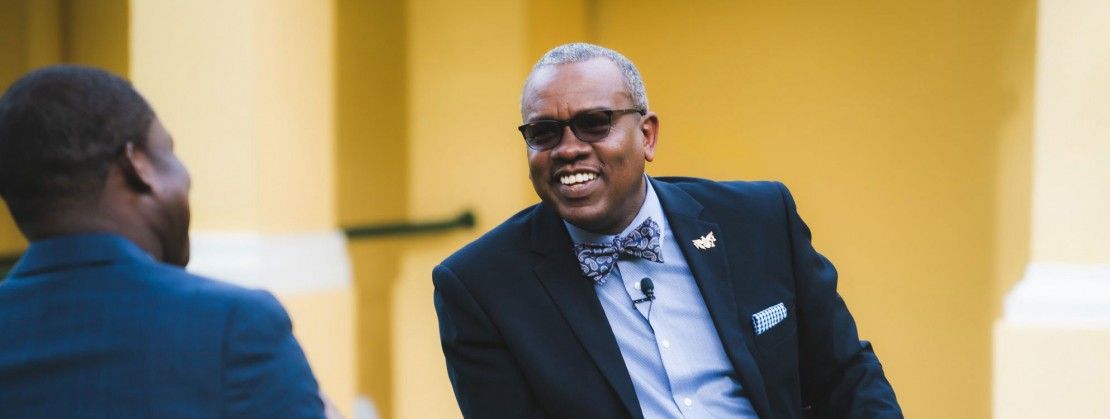
Albert Bryan Jr. ’89 is changing the course of the U.S. Virgin Islands.

Albert Bryan Jr. ’89 tells the story about asking one of his daughters if she knew how to climb a tree. Her response was that she did not climb trees. He then asked how she’d be able to get fruit to which she replied, at the supermarket.

This story explains Bryan’s attitudes toward conservation.

“Conservation is something I grew up with,” says Bryan, who was elected Governor of the U.S. Virgin Islands (U.S.V.I.) in 2019.

“On an island, garbage is a problem, so I grew up with one garbage bag a week. We recycled. Bread went to the chickens. Bones to the dogs. We drank out of jars.

“Now, just in water bottles alone you can fill a landfill,” says Bryan, who grew up on St. Thomas and now lives in St. Croix.

“And as a kid, if you wanted fruit you picked it from a tree.

“The islands are surrounded by natural beauty with a lot of natural wealth—everything is there to eat and drink. Fruit hangs on trees. We catch water in our cisterns. But we have to conserve what we use.

“It’s like living in a garden,” he adds.

“I grew up living close to the ground. If something broke, we fixed it rather than buying something new. We need to go back to living close to the ground.”

Because over 30 percent of the population is on public assistance, Bryan ran on a platform of changing the course of the U.S.V.I., which meant not just focusing on conservation, but also reducing poverty over the four islands he presides—St. Thomas, St. Croix, St. John, and Water Island, a population of 110,000.

“Education fixes poverty.”

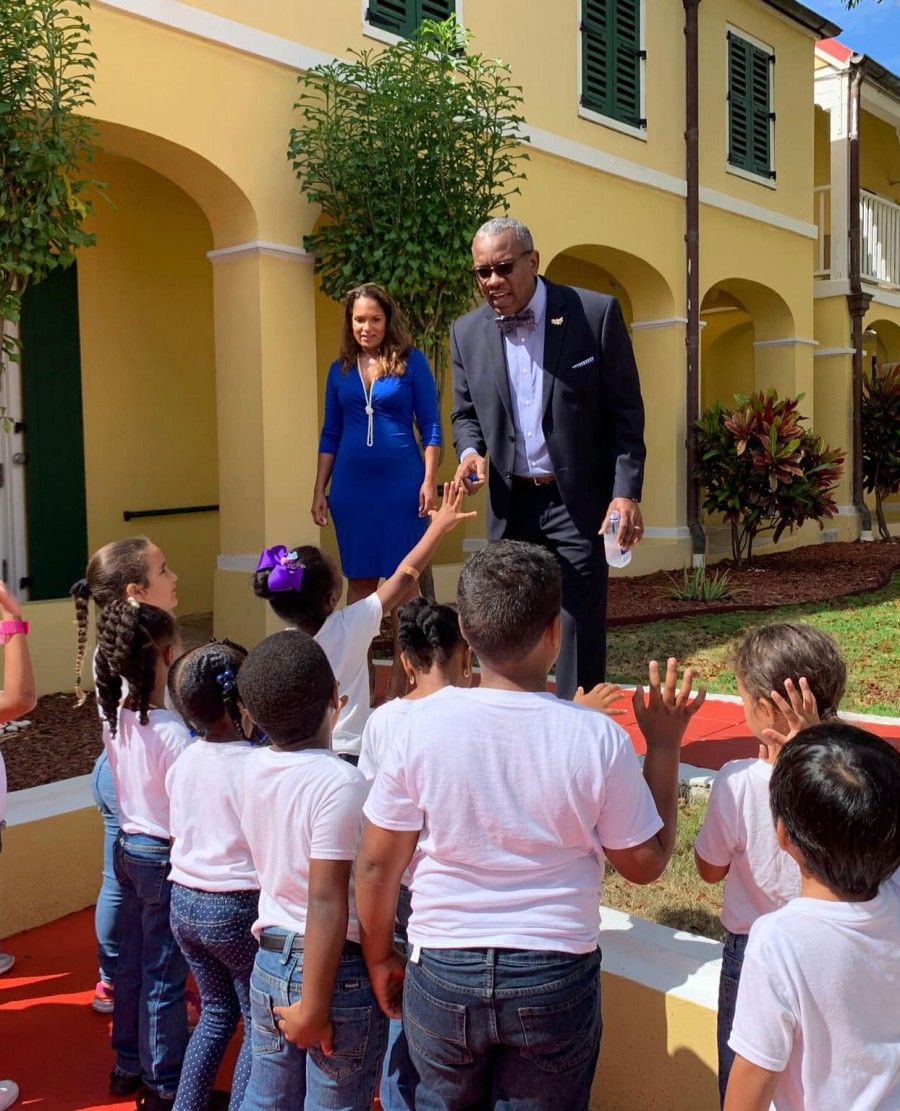
To this end, Bryan makes sure to visit schools because he wants the kids to understand that education is the key to a better life, an important message because only 17 percent of Virgin Islanders have a college degree, which is why his government now offers free tuition to the University of the Virgin Islands (U.V.I.) to anyone who graduates from Virgin Islands High School.

“I go to schools all the time because I want the kids to feel important. I’m not that important, but the office is. The ability of me to carry the office wherever I go so the kids think, ‘Wow, the governor wants me to succeed and is interested in us.’

“My goal is to help people get a better life through education, which will help them earn more and bring more money into the community,” says Bryan, who graduated from Wittenberg with a degree in economics and earned his MBA from the U.V.I. in 2003.

Bryan put a lot of stock in Wittenberg, moving almost 2,000 miles away from home to pursue his liberal arts education. One of his first lessons took place during his first winter at Wittenberg— a lesson one can only understand if one grows up on a tropical island.

“Wittenberg was a challenge in terms of the weather. I figured out why ‘they’ have heat in cars. That’s what that’s for. I grew up wondering why ‘you’ would put heat in a car.”

In terms of academics and preparing for his future, Wittenberg was the perfect laboratory for the future governor. His career track has reflected Wittenberg’s success in producing problem-solvers, critical thinkers, and creative graduates who can adapt and succeed wherever they land. He has pursued such diverse paths as an oil refinery worker, business office manager of a multimillion- dollar Virgin Islands corporation, commissioner of the Virgin Islands Department of Labor, and an entrepreneur focused on strategies to create business opportunities and career paths for others. He also inspired future generations in financial literacy and leadership as executive director of the Virgin Islands branch of Junior Achievement USA.
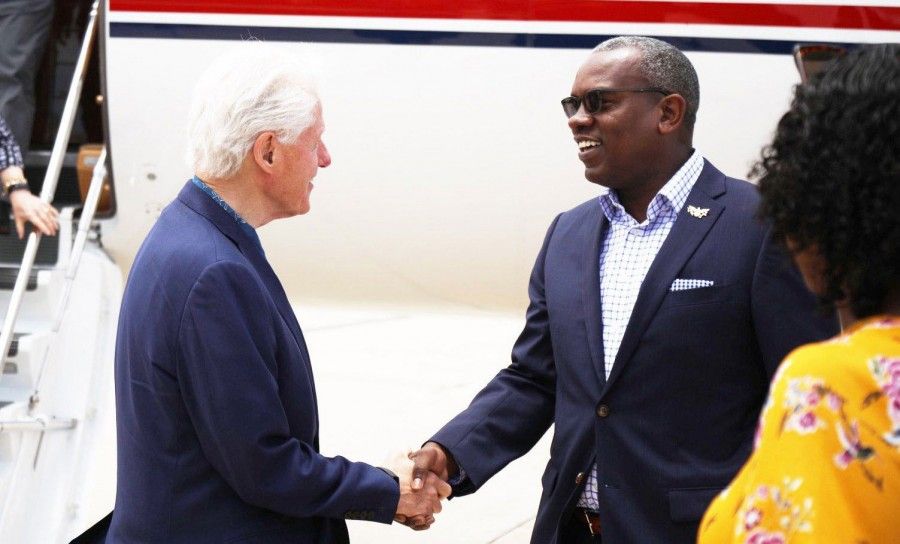
“The academic and life lessons I experienced at Wittenberg (which included a change to economics from political science as my major) presented me a broader perspective for achieving a successful career path when I returned home,” Bryan says.

“Political science didn’t offer me the excitement that I thought it would. The lure to the economy and its constant movement seemed practical, and it all made tremendous sense to me. I continue to use that education every day, and economic development is the cornerstone of our platform.”

Bryan assumed office on Jan. 7, 2019, but before he really had a chance to champion his new platform, Hurricane Dorian blasted the Caribbean. Sparing the U.S.V.I., the Category 5 hurricane left a wake of death and destruction in the Bahamas, specifically Grand Bahama, to the score of 65 deaths, another 282 people left missing, and damages estimated to run over $7 billion.

Virgin Islanders need no reminder about the danger of hurricanes. They have been in recovery mode for the past two years after being hit by two Category 5 hurricanes, Irma and Maria, which struck within weeks of each other in September 2017. The devastation led Bryan and his team to work on three main issues in addition to education: stabilizing the government and restoring trust and transparency; ensuring the recovery process is smooth and efficient and moves at the fastest speed possible to bring comfort to residents and prosperity to business owners; and building a sustainable economy.

“The community has been through this a few times. We know what to do. The day after a storm we clean our house. All the water and debris. And then you go out to the road, and people start clearing the road. You then work your way from your house down to the main road. You set up communications. You report to work. See who is not there. And then people go out checking on those who didn’t report.

“And then you just keep going,” Bryan says.

Bryan says that the islands have spent years working on the response to these natural disasters, and there are territorial emergency operations plans in place for future storms, but what many politicians in Washington, D.C. fail to recognize is that if there’s a hurricane in Florida, residents can drive away to other economic centers that are out of the storm’s reach, and therefore still functioning.

“On our island, it all stops,” he says.

In the aftermath of hurricanes, images of death and destruction beam across the country (and world), leaving many to wonder why residents continue to live in the well-travelled hurricane path.

“I lived for 21 years before I saw my first major hurricane,” Bryan says. “Then I saw another and another. The reality of global climate change is that we have to build our homes differently and facilities differently. That’s the reality in which we live today.”

Bryan also recognizes that wherever people live the realities of global climate change affect everyone—from wildfires in California, to flooding rivers in the Midwest to droughts in the Western plains to bitter cold New England winters to Caribbean hurricanes with tornadoes living inside them.

“We in the islands are just the first people to feel climate change,” he notes, explaining that meteorologists were perplexed by Hurricane Hugo in 1989 because the storm struck with the added strength of a tornado, thought to be a rare phenomenon.

“Scientists thought this was impossible. Now it’s the norm.”

No one can obviously control the weather, but to combat climate change Bryan returns to the story he told about his daughter’s inability to climb trees.

“We have to adjust our living to be more sustainable. We need to go back to living close to the ground.”

Wittenberg Magazine | Winter 2020 | Features

The Governor