
Wittenberg Community,
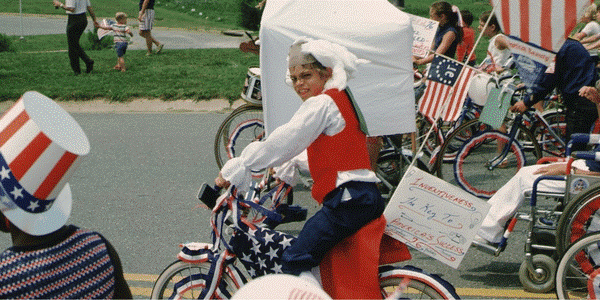
I remember our nation’s Bicentennial. We lived in a new, planned community full of young families, where the centerpiece of the annual celebration was the bicycle parade. Each year we would decorate our bikes and dress up. Just short of my eighth birthday, in 1976, my mother made me a vest and breeches, and, along with a bald wig, wire frame glasses, and a pole sticking up from the back of my bike with a kite attached, I was transformed into Benjamin Franklin, the great inventor. The sign on my bike, adorned with a light bulb and a telephone and lettered by my engineer father (who also influenced this whole concept) read “Inventiveness: The Key to America’s Success."
Anniversaries and birthdays are times of celebration, as well as reflection. In some ways, it feels less dramatic to consider how far we have come in 250 years. Two and a half centuries ago, horses and carriages provided locomotion (It would be another 40 years before bicycles would be invented), and communication took weeks or even months. The past is supposed to be the past, so horses and oddly shaped hats seem appropriate, but 1976 still seems like it was only yesterday. Aside from polyester paisley pantsuits, things cannot have changed that much, can they?
Certainly, when it comes to communication it has. In 1976 phone calls had to be made from the house or the office, with a handset wired into the wall. Cars haven’t changed that much, and we still haven’t put another human on the moon, and yet today anyone can speak to anyone else in the world immediately. Any and every idea can be disseminated, unfiltered directly to a small device held in the hand. That same device can also now translate languages on the fly, edit images, and produce films, all with minimal effort by the user and with artificial intelligence embedded inside.
One thing that has not changed in 250 years, in two millennia and more, is what it means to be human. Lightbulbs and telephones, artificial intelligence and self-driving cars are simply tools. More sophisticated than the wheel or the astrolabe, they are nonetheless devices made by humans to enable humanity to do more. The American Revolution put into practice the principles espoused by Aristotle, Cicero, and Locke that allowed us to be more.
It was on July 2, 1776 when the Second Continental Congress approved the resolution of independence, and two days later, on the 4th of July, the formal Declaration of Independence was signed. The delay was caused, in part, because of a debate over whether or not to include Thomas Jefferson’s denunciation of King George III’s encouragement of the transatlantic slave trade. It was ultimately removed, leaving the words of the preamble to provide the foundation upon which our country has been able to build and evolve.
"We hold these truths to be self-evident, that all men are created equal, that they are endowed by their Creator with certain unalienable Rights, that among these are Life, Liberty and the pursuit of Happiness.”
At the time, “men” meant not simply males, but white, land-owning ones, yet the language was there, borrowed from Locke who was preceded in formulating the phrase by Pope Gregory the Great in the 6th century. The foundation was laid, not only for the freedom of a nation from England and the monarchy, but for true equality for everyone. The foundation was laid, yet the house had to be built upon it.
Over the decades and centuries, stumbling in the dark, the American people have built that house of freedom, one brick at a time. On occasion, we have had to shore up the foundation. We have added walls and structure to this great house, eventually extending these unalienable rights to all humans. We seek to form a “more perfect union,” as our Constitution declares, one that includes justice, peace, and liberty for all. Perfection is rarely achieved, and our nation’s founders understood that fact, establishing a means for amendment of our Constitution, a bicameral representative government that works in concert and tension with the executive and the judicial branches.
A look at writings about Wittenberg offers us insight into a similar balancing act, as “Having light we pass it on to others” is not simply our motto; it is our purpose. The phrase actually comes from an episode in Plato’s Republic, Book I, and it serves as a metaphor for the importance of educating each successive generation. As Wittenberg President Emeritus William Kinnison wrote, “Socrates…engages in a debate about justice and injustice, what the older generation owed to the younger generation, and what the wealthy owed to society. They were to be the guardians of a free society. Teachers were to be the educators of those guardians of the republic.“ (William A. Kinnison, Modern Wittenberg, [2011], p. 355.)
Our union is not perfect. We are not perfect. But we are inventive, creative, and capable of growth. Each succeeding generation builds upon the success (and failures) of our predecessors, guided by the founding principles of equality, justice, peace, and liberty for all. This is nothing less than the purpose and mission of the liberal arts: to educate and empower our students to enter into the public arena and move us toward that more perfect union.
Yours,
Christian M. M. Brady, DPhil (Oxon.)
President