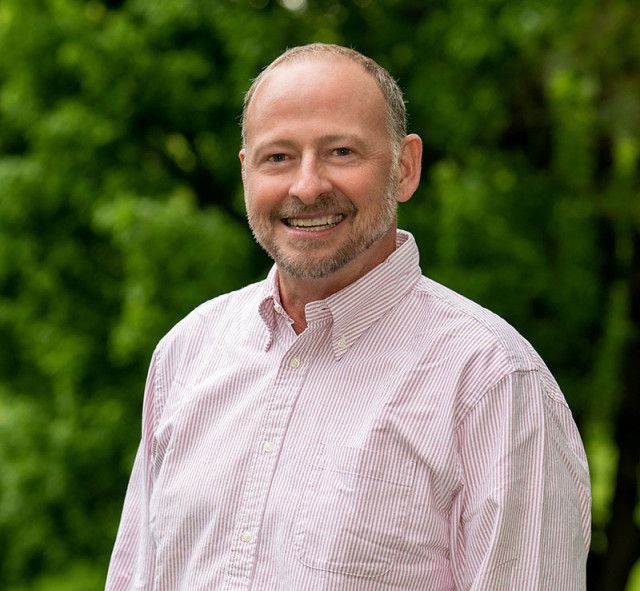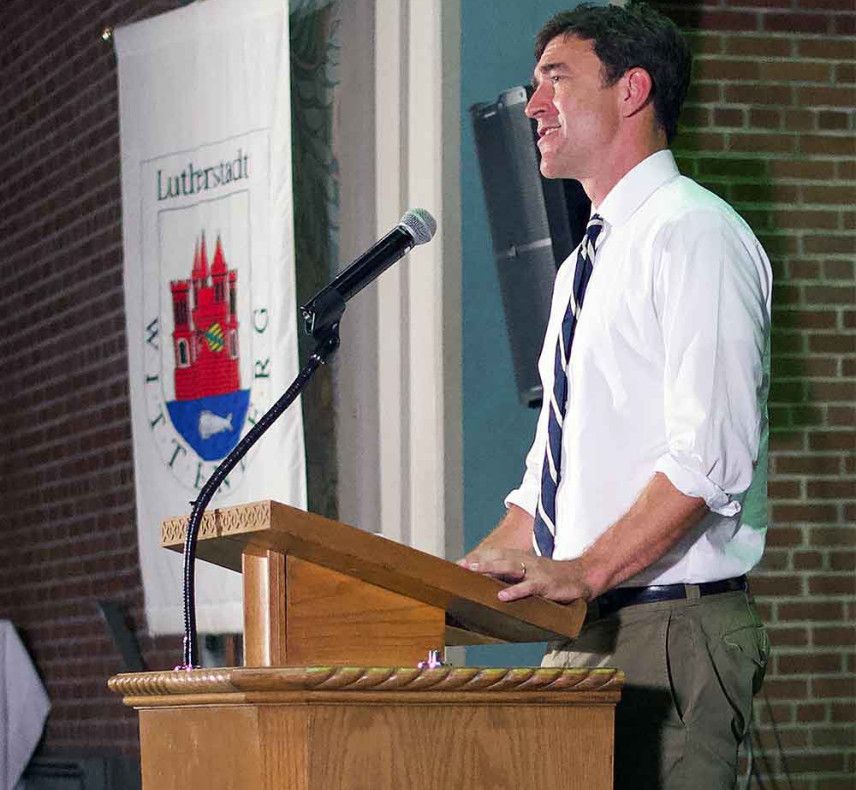
SPRINGFIELD, OH. – Jeff Hobbs, New York Times bestselling author, Guggenheim Fellow, and last night’s Wittenberg Series’ Fred R. Leventhal Family Lecture keynote speaker, presented a moving, thought-provoking address around race, class, and identity in American universities, as he shared his own journey of loss following the tragic death of his Yale University roommate and friend, Robert Peace.
What started out as a 1,000-word letter about his roommate became something much more as Hobbs recounted the experience in his book, The Short and Tragic Life of Robert Peace (2014), which the Los Angeles Times hails as “an honest, insightful, and empathetic account.” The book, in addition to being a New York Times bestseller, an LA Times Book Award winner, and a finalist for the Carnegie Medal and PEN Award in biography, was adapted into the 2024 film ROB PEACE.
In his evening remarks, Hobbs took those in attendance back to his student days at Yale University, from which he graduated in 2002 with a B.A. in English language and literature and where he currently teaches nonfiction writing. He recalled his friend’s ability to make a difference simply by showing up in a room.
Following Peace’s death, and after speaking with so many of those who knew Peace well, Hobbs affirmed that Rob Peace was indeed “The Man,” and that was “definitely how he projected himself—strong and self-assured.
“That’s how I thought of him always,” Hobbs relayed to the audience gathered at Weaver Chapel. He also shared how he realized through this commonality that people can get so accustomed to looking at someone, even someone they know deeply, through a single lens.
“We were so habitual in seeing Rob as ‘The Man’ that we all forgot that he was also ‘a man.’ A man with insecurity, fears, shame, needs. About his mother, his father, his potential, his dreams, reality. And we just never asked and so we never knew. And that’s really what the book is about: knowing each other, allowing ourselves to be known. Asking and answering.”
Hobbs invited the audience, and especially students at the event and those he met earlier in the day, not to wait to learn the stories of others, noting that he learned so much about his best friend 10 years after college, after he was gone, when it was too late to ask him. To drive this point home, Hobbs asked several questions of audience members to show those present that the person sitting right next to them may have a fear, a different upbringing, or a similar reflection on family, finances, education, and more.
“Institutions do so much now. Young people in college and university settings like Wittenberg are surrounded by adults whose life purpose is to help them and support them and promote belonging and safety across differences,” he said. “That really matters, and I hope everyone here feels that and can attest to that.”
Hobbs also shared how he hopes these efforts percolate across the spaces that are not overseen or structured by adults in the same way—sports fields, dining hall tables, dorm rooms. Because in this precious passage, he explained, the potential to be fulfilled and connected in life really does hinge on how people treat each other.
“You’re here. It’s a small campus, and a beautiful campus, populated by smart and caring people who are here for each other,” he continued. “I’ve had the privilege of visiting some of these spaces today. You’re here for a few years. Take this time to know each other in the small moments—to say this is my story, tell me yours. And just talk a little bit and just listen a little bit. It matters so much. Real conversations in safe spaces, learning about who we really are and how we really feel—that was the power of the experience I had telling Rob Peace’s story. And that was the most personally close and connected story I’ll probably ever tell. But all my work since then has in some way been based on that quiet enchantment of just listening and learning how different people experience the same moments in different ways.”
Since 2014, Hobbs has visited more than a hundred schools – from high schools and juvenile halls to colleges and universities – to facilitate conversations about access, entitlement, racism, classism, justice, and identity in modern-day America.
“In that book and the books I’ve written since, I’ve had conversations with so many people who share some of those threads—a fractured family, poverty, imprisonment—and worked hard to be accepted to a dream school and then carried their own experiences, their own influences and formation, silently through school because they felt that not being silent about their differences somehow signaled not belonging. These are people who now have jobs they are fulfilled by, families and homes, and full lives, but a lot of them, grown men, cried openly in front of me because that feeling of isolation still trailed them a decade or more later. These feelings, these kinds of big feelings, have a lot to do with race and class, gender, orientations. Forming your identity, projecting it in your community, establishing it in the world—it’s big, existential stuff.”
Hobbs went on to note that these are the kinds of stories he is drawn to tell—for the most part decent people trying to lead decent lives while living and working in difficult systems and cycles. There are people moving through their days, day by day, and making decisions, sometimes seismic decisions but often very innocuous decisions, trying to make sense of the world as it unfolds before them and trying to form and then sustain some vision for how they want to inhabit that world, he explained.
Hobbs has written five books to date with his latest work, Seeking Shelter: A Working Mother, Her Children, and the Story of Homelessness in America, being published in 2025. The book won the Lukas Book Prize earlier this month and has been named a best book of the year by Amazon and The New Yorker. Seeking Shelter follows the story of a single mother of six in Los Angeles facing homelessness and poverty. Hobbs is also the author of The Tourists (2007), Show Them You’re Good (2020), and Children of the State (2023).
During his time on campus, Hobbs attended a fireside chat hosted by Senior Professor of Practice Erin Hill in the University’s Department of Education, met with students in Professor Emerita of English D’Arcy Fallon’s journalism class, and joined the Leventhal family, Wittenberg President Christian M. M. Brady, and several students, faculty, and staff for dinner prior to his address.
This Wittenberg Series event is made possible annually through a gift to Wittenberg University from the Fred R. Leventhal family. Free and open to the public, yesterday’s lecture served as the final event of the 2025-2026 Wittenberg Series, now in its 41st season.
Created in 1982 during President Emeritus’ William A. Kinnison’s tenure, the Wittenberg Series has brought Nobel Laureates, scientists, significant literary figures, most of America’s foremost modern dance companies, as well as hundreds of prominent psychologists, educators, economists, writers, theologians, urban planners, and historians to campus.
For more information on the Wittenberg Series, click here. To make special arrangements or become a friend of the Wittenberg Series, contact the Wittenberg Series planning committee at wittseries@wittenberg.edu.