For generations, Myers Hall and its vibrant red color have welcomed thousands to Wittenberg as the University’s cherished centerpiece and first structure. The original Wittenberg, built by founder and first president Ezra Keller and the University’s first students, Myers Hall is steeped in tradition and holds significant pride among Wittenberg alumni. Within and around Myers Hall, friendships formed, lifelong connections began, and a shared sense of place developed in graduates as they prepared to pass their light.
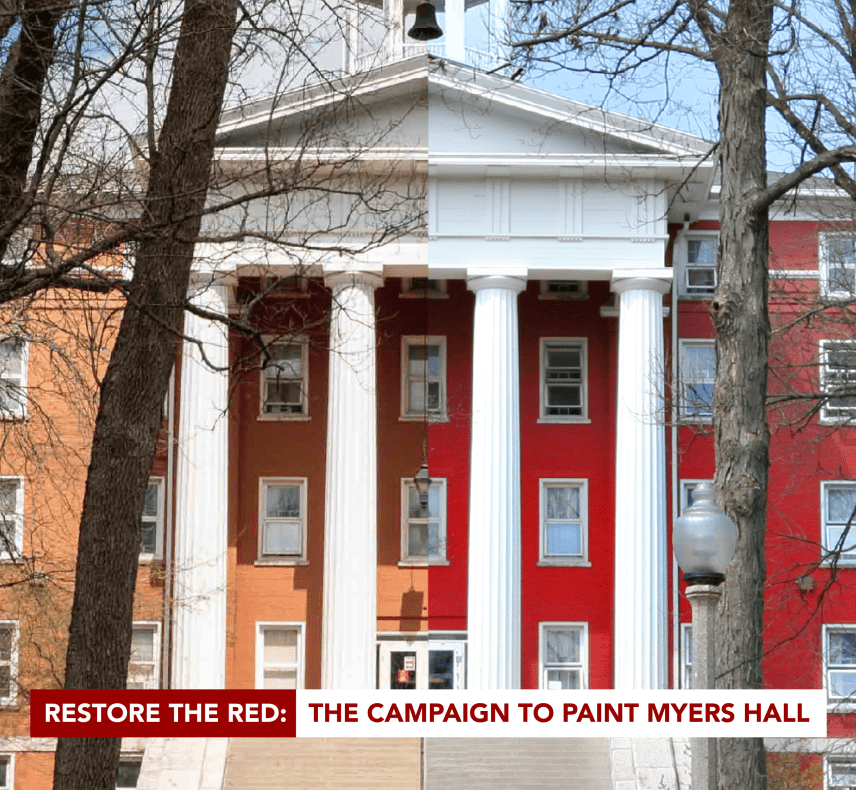
Unfortunately, time has changed Myers Hall’s facade, fading its treasured red color into an orange hue and saddening alumni and friends throughout the years. Intent on changing this course and at the enthusiastic urging of numerous alumni, the University is excited to launch “Restore the Red: The Campaign to Paint Myers Hall.” With this campaign, the Wittenberg community has the opportunity to come together for a simple but meaningful effort: restoring the exterior of Myers Hall and returning it to the look generations of Tigers remember.
Led by Wittenberg’s Office of Philanthropy and Alumni Engagement, the $250,000 mini campaign will bring new life to Myers’ exterior and bring the building’s iconic cupola back to prominence. To make a gift, visit https://tinyurl.com/RestoretheRed. The campaign will run through the summer with plans for the big reveal of Myers Hall's restored facade occurring during Homecoming, Reunion, and Family Weekend, October 1-4, 2026.
“What we are about to do is more than mere preservation; it is a statement of continuity, community, and a fervent belief in Wittenberg’s future,” explained Michael McGreevey, vice president for philanthropy and alumni engagement. “Together, we can ensure Myers Hall stands tall, restored to its full character and meaningful stature, as it graces the ‘lovely spot’ that our founder Ezra Keller envisioned more than 180 years ago.”
About Myers Hall
As the first building constructed on campus, Myers Hall holds a special place in the hearts of alumni especially. Located at the highest point on campus, the building is listed on the National Register of Historic Places. In fact, at its inception, all the classes at Wittenberg were held in the structure. Working side-by-side, students and faculty helped build the original east wing of the building, which opened in 1846. Work began on the additional wings in 1850 and were completed by December 1851. An extensive renovation in 1916 was made possible by the Myers family of Ashland, Ohio. The building was then rededicated and named after the family. In recent years, Myers Hall served as the home for students admitted to the University’s Honors Program. A co-ed facility, Myers can house up to 142 students on five floors.
Here are a few historical facts about Myers Hall:
- Named to the National Register of Historic Places in June 1975
- Re-dedicated in October 1976 by a group of Myers Hall residents, the one-time all-male residence hall welcomed then State Representative David Hartley, along with Dr. William A. Kinnison, 11th president of the University, and Harry Walters, Myers Hall custodian, who cut the ribbon.
- Built with stone excavated from the southwest part of campus.
- Total cost of the project was $28,000.
- Myers was originally an all-in-one dormitory, classroom building, chapel, and meeting place.
- Prior to 1916, the building was referred to as the Old Dorm.
- In 1916, the Myers families of Ashland provided $20,000 for an extensive renovation.
- The brick building was originally painted in 1866. It was then repainted in 1916 with funds from the Myers families.
- A renovation that began in 1946 included adding the college’s first Student Union.
- A bigger remodeling effort began in 1954.
- Dorm League was “an early fraternal organization reserved for those men living in Myers Hall” and continued to be highly popular through the mid-1960s.
- In 1979, restoration grants from state and federal agencies allowed an extensive renovation of the exterior, including repainting.
- By 1989, Myers underwent another interior renovation.
According to the National Register application, the architecture of the building is described as Late Greek Revival. “Architecturally, Myers Hall is significant primarily because it is representative of the transition from the Greek Revival in college architecture early in the Nineteenth Century. The variations in the construction of the building from its beginning in 1846 to its completion in 1852 and in its substantial remodels in 1892 and 1916 add to the architectural interest of the structure,” the document details.
An urban legend regarding Myers Hall involves a horse that haunts the dorm and the University’s main Hollow. According to the tale, Myers Hall was used as a Civil War hospital to house ill soldiers. A fatally wounded general of the war, who was staying in the hospital, requested to see his horse before his death. However, the horse was unable to make it back down the flight of stairs after the visit and thus had to be put down. Since then, the spirit of the animal is said to live on in Myers Hall and in the nearby rolling hills of the Hollow.
Through the Restore the Red campaign, alumni can leave a collective mark, one that current students will see every day and that future generations will inherit. In honoring all who have called Wittenberg home, this effort also reflects the enduring connection shared across generations of Tigers.