
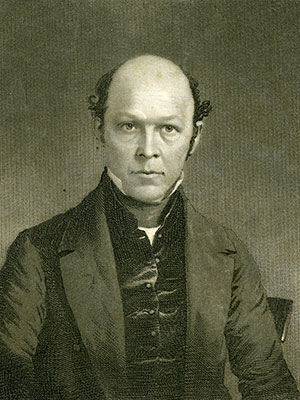
 Ezra Keller
First President, 1845-1848
Ezra Keller was the founder and first president of Wittenberg. He was born on a farm near Middletown, Maryland, in 1812. At 17 years of age, he left home to study to become a Lutheran minister. He entered the Preparatory Department of Gettysburg College (Pennsylvania) and graduated in 1835. He was appointed by the Pennsylvania Synod as an itinerant missionary to Ohio, Indiana, Illinois, and Missouri. When he returned, he became pastor of the Lutheran church in Hagerstown, Maryland. Ezra Keller was a grandson of a German immigrant, and Keller writes in his diary, “I am every day becoming more convinced of the necessity of raising up an American ministry to spiritualize the millions of Germans who are seeking a home in our happy land.” He was called in 1844 to a professorship in the Lutheran seminary located in Wooster, Ohio. This institution was moved to Springfield, and Wittenberg College was founded in 1845. Ezra Keller worked tirelessly, securing the property for the institution, asking support from the Springfield community, traveling to raise funds, establishing a library for the students, and beginning construction of Myers Hall. Ezra Keller died December 29, 1848 at age 36 of typhoid fever.
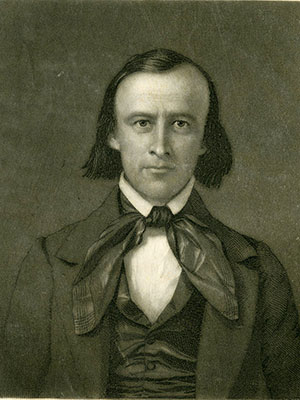 Samuel Sprecher
Second President, 1849-1874
Samuel Sprecher was born in 1810 near Hagerstown, Maryland. He was also a grandson of German immigrants and attended Gettysburg College, graduating in 1836. He was primarily a minister before being appointed by the Board of Wittenberg to become its second president after the sudden death of Ezra Keller. Myers Hall was competed in 1851, and it was under his presidency that the school became coeducational in 1874. He remained at Wittenberg another 10 years as a professor until his retirement in 1884. Students described him as “a preacher of rare power. As a teacher, he excelled. Clear and concise in his treatment of the most difficult subjects, he led his students to think for themselves.” He moved to San Diego, California, soon after retiring, and lived until his death in 1906.
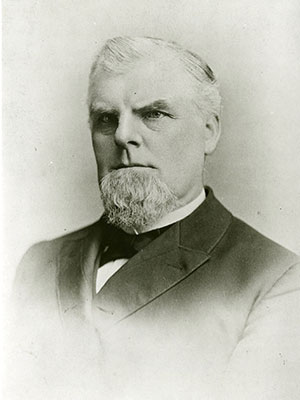 John Helwig
Third President, 1874-1882
John Helwig was born in 1833 in Canal Dover, Ohio. He was a blacksmith before entering Wittenberg College, where he graduated from in 1861. As a student, he represented the Excelsiors (a literary society) in two contests. He became a Lutheran minister and served as pastor in several churches in Ohio and earned a Doctor of Divinity in 1875 from Union College. In 1869, he was the chair of the Alumni Association, which established an Alumni Association Endowment fund. After Dr. Samuel Sprecher retired, he was appointed Wittenberg’s third president in 1874. He was known as a powerful preacher and a strong administrator. Contemporaries described his administration as “strong, strenuous, thorough, and forcible.” He resigned after eight years as president due to ill health. He later (1889) became a candidate for Governor of Ohio on the Prohibition ticket and left the Lutheran church to become the pastor of the First Presbyterian Church in Urbana. He died in 1904.
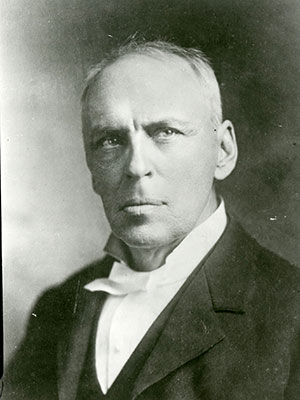 Samuel Ort
Fourth President, 1882-1900
Samuel Ort was born in 1845 in Lewiston, Pennsylvania. He entered Wittenberg College at the age of 16, and graduated first in his class in 1863. He attended seminary for two years and became a minister in Findlay, Ohio. In 1869, he became a professor of math, literature, and logic. After five years, he returned to being a minister in Louisville, Kentucky, and New York City. In 1880, Wittenberg offered him a chair in Sacred Philology, and two years later became its fourth president. Ort focused his attention on the university movement in America and sought to change Wittenberg by broadening its curriculum, organizing the work into departments, and adding graduate level courses. For example, under his presidency the subjects of music, art, and physical education were added to the curriculum. Recitation Hall (1883), Ferncliff Hall (1887), Hamma Divinity (1889), the Gymnasium (1889), and Zimmerman Hall (1893) were also built during his time as president. After retiring as president, he taught an additional 11 years at Wittenberg. Ort died in 1911.
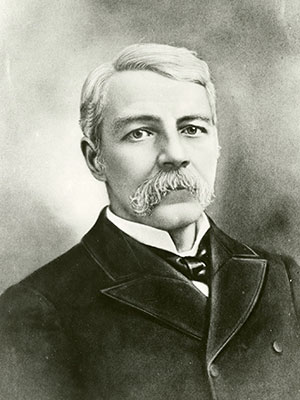 John M. Ruthrauff
Fifth President, 1900-1902
John Ruthrauff was born in 1846 near Canton, Ohio. He enrolled in Mount Union College, but left in 1864 to fight in the Civil War. He returned to college, this time enrolling at Wittenberg, and graduated in 1871. While in school, he was an active member in athletics and debate, and was a member of Beta Theta Pi. After graduation, he was sent by Samuel Sprecher to Louisville to organize a congregation and was there until 1874, when he was succeeded there by Samuel Ort. He served several churches afterwards, and was an active worker for temperance and for physical fitness among pastors. In 1895, he was appointed president of Carthage College (Wisconsin). His success there led to Wittenberg’s Board to appoint him as its fifth president in 1900. He had a vision for “a greater Wittenberg,” a university with a liberal arts college, with schools of music, theology, law, medical and graduate studies – “a full comprehension of the needs of higher education.” He also redesigned Wittenberg’s Seal. He died suddenly after only 19 months as president in 1902.
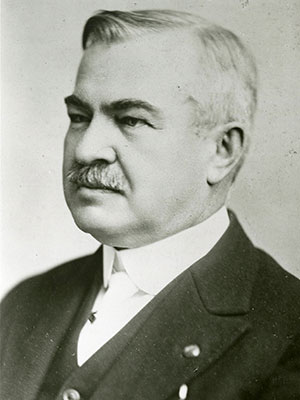 Charles G. Heckert
Sixth President, 1903-1920
Charles Heckert was born in 1863 in Northumberland, Pennsylvania. He enrolled at Wittenberg in 1880 at the age of 17. After two years, he left to teach, but he returned to Wittenberg to complete his studies, graduating as valedictorian of his class. He was active in the Excelsior Society, the State Oratorical Association, and Beta Theta Pi. He was also a manager of the football team and a pitcher for the baseball team. In 1893, he became a professor of English and logic at Wittenberg. While Ruthrauff had endorsed the idea of Wittenberg as a University, Heckert was an advocate of Wittenberg as a liberal arts college. With Heckert’s appointment as Wittenberg’s sixth president, the ideas of graduate-level programs, law, and medical schools were dropped; however, an expanded liberal arts program that would include certain kinds of vocational training at the undergraduate level was adopted. Heckert was a proponent of modernism and felt that the college should provide a climate of respect and support for all beliefs. In this more supportive climate, Wittenberg’s first Jewish students enrolled and a Newman Club for Catholics was established. Carnegie Science Hall was built in 1909, a new entrance to campus was started, electric lights were installed in buildings, and dirt sidewalks were paved. New Ferncliff Hall was dedicated in 1914. In 1916, the men’s hall was renovated and renamed Myers Hall, adding pillars to the front of the building. In that year, Wittenberg was approved by the North Central Association, becoming one of the earliest Lutheran schools to be accredited. Heckert led Wittenberg through WWI and its anti-German sentiments. He resigned as president in 1920 and died later that year.
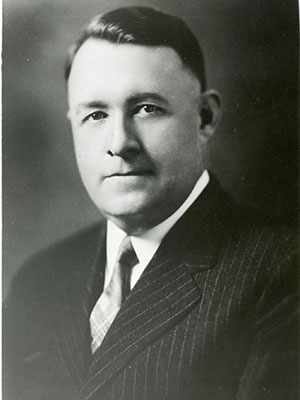 Rees E. Tulloss
Seventh President, 1920-1949
Rees Tulloss was born in 1881 in Leipsic, Ohio. He graduated from high school before the age of 15, was assistant postmaster in Leipsic, and founded the Tulloss School of Touch Typing by the age of 20. He entered Wittenberg College in 1902 where he was the captain of the football team, acted in school plays, and was active in his fraternity. He then studied at the Hamma Divinity School, Johns Hopkins, and Harvard Universities. He later served the parish ministry in Michigan and Ohio. In the early 1920s, Wittenberg’s enrollment had regained pre-World War I levels and had doubled by 1928. As Wittenberg’s seventh president, Dr. Tulloss’ first responsibility upon assuming the presidency, however, was finances. With the success of a $1.5 million campaign in sight and the promise of substantial support from the church, the college began construction of a new Field House, Koch Science Hall, and Blair Hall. Dr. Tulloss initiated modern administration at Wittenberg. He formalized the administrative process, established divisions of executive function, and freed faculty from responsibilities of fund raising and student recruitment. The combining of the Summer School and the Saturday School and the creation of a department of Special Schools represented Wittenberg’s earliest formal movement into the area of community and adult education. Under his tenure, theatre, debate, athletics, music, and the Greek system all grew. In 1923, Wittenberg was one of the first Ohio colleges to have a broadcasting radio station. In 1947, the Fighting Lutherans became the Wittenberg Tigers. Tulloss led Wittenberg through the Great Depression and World War II. He retired in 1949 and died in 1959.
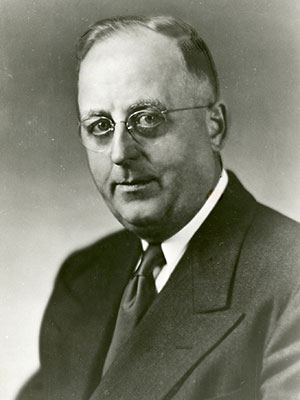 Clarence C. Stoughton
Eighth President, 1949-1963
Clarence Stoughton was born in 1895 in Rochester, New York. He graduated from the University of Rochester in 1918 and Columbia University in 1922. He served as a corporal in WWI in the 21st Aeriel Photography Section. He was president of Wagner College from 1935 to 1945. He then was the executive secretary of the Lutheran Laymen’s Movement for Stewardship and the Secretary for Stewardship of the United Lutheran Church in America in 1945. He became Wittenberg’s eighth president in 1949 and was the first layperson to hold this position. Dr. Stoughton was largely responsible for Wittenberg’s growth from an institution with 14 buildings and 917 students at the outbreak of the Korean War to one with 30 buildings and 1,866 students. He capitalized on the restored prosperity of the 1950s to bring Wittenberg’s economic affairs into balance. In the early years of his administration, the first woman was seated on the Wittenberg Board of Directors. Dr. Stoughton expanded the student personnel program and, for the first time, the school had a full-time college pastor. The aim of his program at Wittenberg was to improve the quality of academic programs, strengthen the institution’s ties with the community of Springfield, and emphasize the church relationship of the college. A major change was the transformation of Wittenberg College to Wittenberg University. Stoughton retired as president in 1963 and died in 1975.
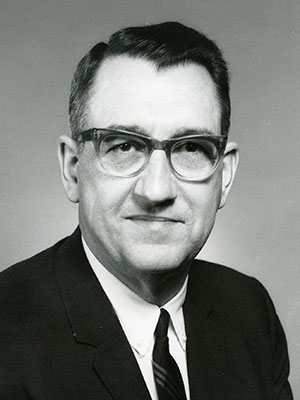 John N. Stauffer
Ninth President, 1963-1968
John Stauffer was born in 1915 in Palmyra, Pennsylvania. He graduated from Juniata College (Pennsylvania) in 1936. He received a Master of Arts degree in psychology from the University of Pennsylvania and earned a Doctor of Education degree at Pennsylvania State University in 1956. Under Dr. Stauffer’s leadership as Wittenberg’s ninth president, Wittenberg made numerous advances. Undergraduate enrollment increased to 2,400, and the number of full-time faculty members increased to 180. Wittenberg’s structure was changed to include a provost, and a new curriculum was introduced in 1966. He was deeply involved in civic activities and was the president of three important community groups: the Clark County Mental Health Society, the Community Welfare Council and the Public Forum of Springfield and Clark County. Dr. Stauffer left Wittenberg in 1968 and accepted the presidency of his alma mater, Juniata College, where he served from 1968-1975. He died in 1983.
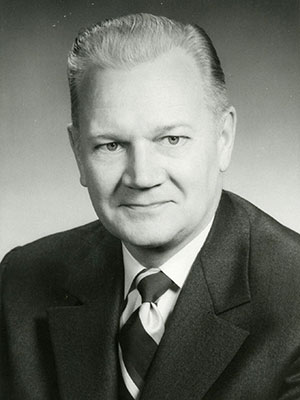 G. Kenneth Andeen
Tenth President, 1969-1974
G. Kenneth Andeen was born in 1918. He was a 1939 graduate of Upsala College and a graduate of the Lutheran School of Theology (Rock Island, Illinois). He earned his Master of Arts and Doctor of Philosophy degrees from Columbia University. He taught for 18 years at Augustana College, served two years as president of Bethany College, and came to Wittenberg from William Rainey Harper College. Dr. Andeen was the first ordained president since Dr. Tulloss. During his tenure Wittenberg was cited as one of the few small private colleges in the nation with both a rising enrollment and a balanced budget. In keeping with the demands of the times, Wittenberg altered many of its educational programs to permit more student control over course selection and content. The changes were made after three years of intensive study, and the resulting programs stressed educational “freedom with responsibility.” Also during his tenure, Wittenberg’s overseas educational opportunities drew increasing numbers of students engaged in study abroad. Dr. Andeen himself traveled extensively to share the Wittenberg story both at home and abroad including to Italy, Switzerland, and The Netherlands. His commitment to international engagement also took him to Japan, where he met with officials at Japanese universities to discuss opportunities for exchange programs in light of the university’s newly created East Asian Studies Program. He resigned from Wittenberg in 1974, and he later served as a pastor of several Lutheran congregations in New Jersey, Illinois, and Wisconsin before retiring in 1986. He died in 2010.
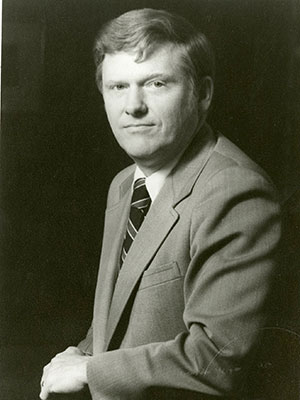 William A. Kinnison
Eleventh President, 1974-1995
William Kinnison was born in 1932 in Springfield, Ohio. He attended Springfield City Schools and entered Wittenberg in 1950, graduating in 1954 with a Bachelor of Arts and in 1955 with a Bachelor of Science in Education. He received a master’s degree in American History (University of Wisconsin), and a Ph.D. in Higher Education Administration (The Ohio State University) and the Institute for Educational Management at Harvard University. He has worked in higher education since the 1950s. In 1974, he was named acting president at Wittenberg and became the University's president in 1975. Some of the highlights of his career include serving on the MacArthur Commission, established to study the future of private education in the United States, serving on the Advisory Committee of the Ohio Board of Regents, and serving on the Task Force on Ethics in Higher Education. He chaired the Commission for a New Lutheran Church, which merged the three Lutheran churches into one denomination, the ELCA. Dr. Kinnison, who believes that Wittenberg has a significant responsibility for good citizenship in the Springfield community, has served on several boards regarding education, business, history, and the arts. He has written several books including the History of Wittenberg and its Hamma School of Theology, Springfield and Clark County. He is an authority on managing private higher education and has published several books and articles on that topic. During his tenure, he led Wittenberg to be granted a Phi Beta Kappa chapter. He also led new facilities and renovations to the campus, including the Thomas Library, the HPER Center, Shouvlin Center for Lifelong Learning and the Student Center, Firestine Hall, Koch Hall, and the Alumni and Visitors Center.He has been awarded the Wittenberg Class of 1914 Award for service to Wittenberg, as well as the Wittenberg Medal of Honor.
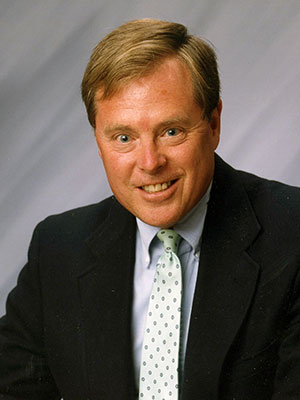 Baird Tipson
Twelfth President, 1995-2004
Baird Tipson graduated from Princeton University (summa cum laude) in 1965 majoring in religion. He was elected to Phi Beta Kappa and earned his Ph.D. in religious studies from Yale University in 1972. He was a Rockefeller Dissertation Fellow, a Woodrow Wilson Fellow, and a Fulbright-Hays Scholar. He taught at the University of Virginia and Central Michigan University before becoming the provost and professor of religion at Gettysburg College (Pennsylvania) in 1987. During Dr. Tipson’s tenure, he oversaw a successful Defining Moments Campaign, the most ambitious fund-raising campaign in Wittenberg’s history, which raised $75 million. As a result of the campaign, Wittenberg constructed Hollenbeck Hall for the humanities, expanded the science facilities in the Barbara Deer Kuss Science Center, and added student housing. Technology across campus was greatly improved as well. He resigned in 2004 to accept the presidency at Washington College (Maryland), and retired from a successful presidency there in 2010. He moved back to Gettysburg and resumed teaching and scholarly research as an adjunct professor at Gettysburg College.
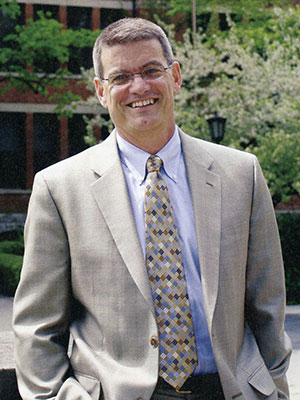 Mark H. Erickson
Thirteenth President, 2005-2012
Mark Erickson received his A.B. in American history from Princeton University, his Ed.M. from Harvard University, and his Ed.D. in educational leadership from Lehigh University. While at Lehigh, he received the Mathew W. Gaffney Award for Academic Excellence. He also completed additional study in world religions and pastoral care at Harvard Divinity School. Under Dr. Erickson’s leadership, the campus built New Hall, and renovated Blair Hall (which was Clark County’s first LEED-certified building), Recitation Hall, the Student Center and the Campus Hollow. Wittenberg instituted a campus-wide recycling program, opened the Eco-House, and developed a Green Wittenberg program. The nationally recognized “Witt Nation Tour” engaged or reengaged thousands of alumni, and the Wittenberg in Wittenberg, Germany program and the East Asian Institute were established. Dr. Erickson also established “Move-In Day.” In addition, numerous innovative and interdisciplinary academic programs were established, including an entrepreneurship program that featured student-run businesses, Languages Across the Curriculum, a Screenwriting Institute, new majors in international relations and financial economics, and minors in sports management and neuroscience. Dr. Erickson believed in a strong bond between the campus and the City of Springfield. Wittenberg’s Susan Hirt Hagen Center for Civic and Urban Engagement is the most visible manifestation of the university’s commitment to community service, civic engagement and economic partnership with the local and regional community. Dr. Erickson was named “Leader of the Year” in 2011 by Leadership Clark County. Dr. Erickson accepted the presidency of Northampton Community College (Bethlehem, Pennsylvania) in 2012.
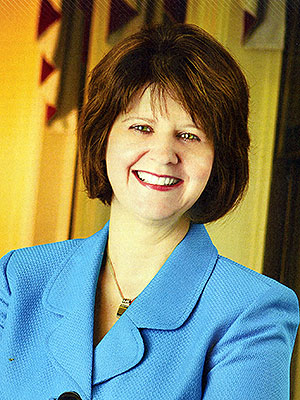 Laurie M. Joyner
Fourteenth President, 2012-2015
Laurie Joyner earned her B.A. in sociology, receiving the Dux Sociologicus Award from Loyola University New Orleans, followed by her master and doctoral degrees in sociology from Tulane University. During her tenure, President Joyner worked collaboratively with other leaders on campus to create new academic and athletics initiatives, student success efforts, and technology upgrades. The investments built on historic strengths of Wittenberg in the areas of business, the health sciences, and athletics. At her direction, the University launched a student success initiative and developed a new value proposition known as “The Wittenberg Commitment” that reenergized the significance of high-impact practices and advising/mentoring in helping students discover their vocation and envision life after Wittenberg. To support this work further, the campus began conversations to establish a Center for Engaged Learning to better serve the needs of students. Similarly, she championed financial support for a $6.5M technology upgrade early in her tenure to address campus needs and support pedagogical innovation in teaching and learning. While at Wittenberg, President Joyner worked tirelessly with her senior staff to produce meaningfully improved results in both student admissions and University advancement; introduced a five-year financial planning model; instituted “best practices” in a number of areas; posted the best two years of financial operating results in at least a decade; reduced total debt by more than $5M in three years; completed important health and safety capital projects; and secured more than $17M in pledges for the new Health, Wellness & Athletics Expansion and Restoration Initiative. Dr. Joyner left Wittenberg in 2015. She later served as the president of St. Xavier University in Chicago, and she is currently the president of St. Norbert University in Wisconsin.
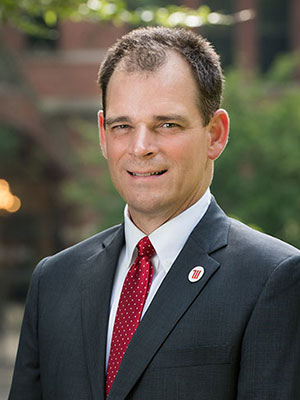 Michael L. Frandsen
Fifteenth President, 2017-2025
Michael Frandsen officially began his tenure on July 1, 2017, and it concluded on June 30, 2025. Respected for his authenticity, integrity, vision, exemplary leadership skills, and unique ability for finding intersections that create opportunity, Frandsen led Wittenberg with a thorough understanding of the rhythms and culture of the academy, the importance of shared governance, the power of an integrated, residential experience, the art and science of enrollment, marketing and fundraising, and the role of community-building in long-term institutional success. During his tenure, Frandsen worked tirelessly to ensure that students learn, grow, and thrive. From investments in new academic programs, such as nursing, exercise science, and engineering, to the expansion of career services, hiring of success advisors, and increase in experiential learning opportunities, to the opening of a fully reimagined Health, Wellness, and Athletics Complex, Frandsen was committed to providing a student-first education. Under Frandsen’s leadership, Wittenberg also successfully completed its historic $100-million “Having Light” Campaign, which generated record levels of giving and alumni participation. Additionally, he has led campus-wide strategic planning and initiated several student success/retention efforts, all designed to advance Wittenberg’s mission and the University’s personalized educational experience for current and future generations. Frandsen came to Wittenberg from Oberlin College, where he served as vice president for finance and administration. Concurrent with overseeing finance and accounting, facilities, human resources, information technology, and investments at Oberlin, Frandsen served on the strategic planning steering committee and the enrollment management team. Prior to joining Oberlin in 2014, Frandsen spent 10 years at Albion College in Michigan, where he held four different roles. Initially a faculty member in economics and management, he went on to serve as director of the Gerstacker Institute for Business and Management, an honors business program, and in 2009, he joined the senior leadership team as vice president for finance and administration. For his final year at Albion, 2013-14, Frandsen was interim president.
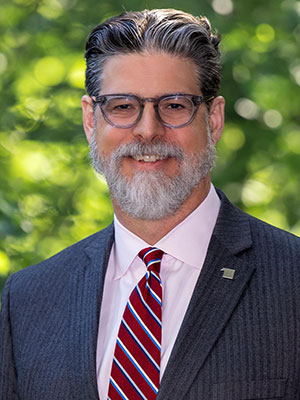 Christian M.M. Brady
Sixteenth President, 2025-present
A transformational administrator, respected scholar, and author, Dr. Christian M. M. Brady began his tenure as the University’s 16th president on June 1, 2025. In his first few months at Wittenberg, Dr. Brady made an immediate impact by launching a strategic planning process, partnering on new recruitment pipelines, securing leadership-level gifts, and instilling a renewed sense of hope in the University among alumni, faculty, staff, students, and families. In August 2025, he served as the keynote speaker for Wittenberg’s Opening Convocation, the traditional kick-off of a new academic year. His address was titled “Hope,” in which he noted that hope "is not simply a belief or an attitude; it is the first action we must take in any endeavor." Prior to leading Wittenberg, Brady spearheaded the creation of the Lewis Honors College at the University of Kentucky (UK), where he also served as the T. W. Lewis Dean, growing the college to over 2,400 students and leading a $50 million capital campaign. As interim dean of UK’s College of Arts & Sciences, he also successfully managed an $81 million budget, 440 faculty members, 19 departments, and nearly 7,500 students. Before joining UK, Dr. Brady transformed the Schreyer Honors College at The Pennsylvania State University into a national model for excellence, tripling its applications, dramatically increasing selectivity, and raising more than $80 million to enhance honors education. Beyond his administrative acumen, Dr. Brady is an expert in ancient Hebrew and Jewish literature, having published extensively and served in leadership roles for organizations such as the Society of Biblical Literature and the International Organization for Targumic Studies. He holds a bachelor’s degree from Cornell University, a master’s degree from Wheaton College Graduate School in Illinois, and a graduate diploma and doctorate from the University of Oxford. Additionally, Dr. Brady is an Episcopal priest and Canon Theologian in the Episcopal Diocese of Lexington in Kentucky.