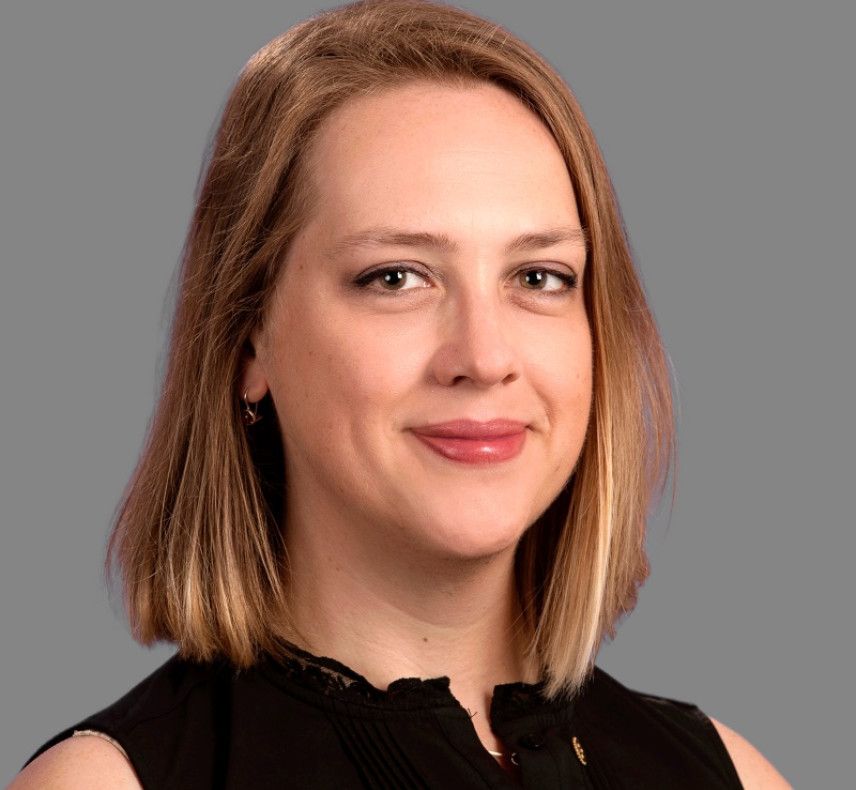
Amanda McLellan, director of Thomas Library, will extend her duties at Wittenberg University and take on the position as the next director of the Margaret Ermarth Institute for Public Humanities, effective immediately.
McLellan has a strong track record of both civic engagement and public programming grounded in humanistic endeavors. Over her four years at Wittenberg, she has built partnerships with the Springfield community that have led to public facing programming, congruent with the institute’s mission of spreading education and knowledge, specifically in the local context.
“Leading the Ermarth Institute for Public Humanities at Wittenberg is a natural extension of her role as director of the Thomas Library as she supports our faculty, staff, and students in public facing work in both roles,” said Brian Yontz, professor of education. We have great confidence in Amanda’s ability to sustain and build intra- and inter- institutional partnerships to achieve the ideal that “the site of learning is not always in the classroom nor on campus,” a core tenant of the institute.
McLellan will report directly to Travis Proctor, associate professor of religion and dean of the School of Arts, Communication, and Cultural Foundations and replacing Christian Raffensperger, professor and chair of history and the Kenneth E. Wray Chair in the Humanities, who served as the institute’s first director.
Serving as director of Thomas Library for the past four years, McLellan has already been doing some of the work the institute exists to do, such as building partnerships, creating public-facing programming, and connecting Wittenberg to the Springfield and Clark County community.
“Applying for the role felt like a natural next step: I wanted to take on that work formally, with the platform and resources to do it more intentionally and at a larger scale,” she said. “In undergrad, I was an art history major and a religious studies classical civilization double minor. I am the recipient of a very humanities-based education at a small liberal arts school, and while my master’s degree and doctorate are not humanities based, my entire career is informed by that humanities background.”
McLellan, who earned her bachelor’s degree in art history at DePauw University, Greencastle, Indiana, a master’s degree in library and information science from the University of Illinois and her Doctor of Education in educational leadership in December of 2021 from East Carolina University, is excited to continue the work of the Ermarth Institute.
“I would love to continue building on the great work of the institute in years prior, especially the speaker series,” she added. “Being able to bridge our own campus experts as well as visiting scholars to a public learning space is essential to the work of the institute. I’m exploring the idea of bringing back the podcast series, especially the idea of having that be student-driven, speaking with students, faculty, and staff on-campus as well as alums and community members here in town. I am interested in exploring grant-funding and partnerships to be able to grow our reach, and possibly explore ideas like community group-reads, panel discussions, and film showings.”
With expertise in academic libraries, leadership, and academic technology, McLellan speaks on literacy, AI and education, digital collections, mentorship, overcoming technology anxiety, and the art of asking better questions. She also has a strong track record of both civic engagement and public programming grounded in humanistic endeavors.
“In this age of rapidly accelerating generative AI, I am more and more convinced that the humanities are the key to shielding our minds and training resilience,” she said. “Humanities should not be a luxury for the few, which makes the mission of the Ermarth Institute even more important. I'm drawn to the institute's core belief that learning doesn't stop at the classroom door, and that education and knowledge are acquired in diverse places across our lives. For Wittenberg, that mission is how the University's commitment to educating the whole person extends outward into the city, county, and region. And for the community, it means the humanities scholarship happening here doesn't stay behind campus walls, it becomes something Clark County residents can access, use, and contribute to.”
McLellan is looking forward to being able to have the resources to provide programming that reaches a wide audience and helps reinforce Wittenberg as a pillar of the educational community of Clark County, while being able to see the direct impact of the power of humanities in the community. She is also asking faculty and staff to share any ideas they may have about possible presentations or workshops to reach out to her.