
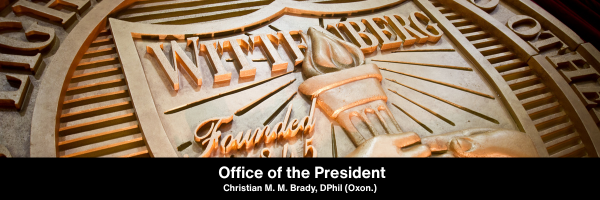
Vision: “Wittenberg will be the model of a liberal arts university in the 21st century, creating sparks that will light the world.”
For the first time in living memory, Wittenberg University has a Vision Statement. It was developed as part of our Strategic Planning work over the last year, the results of which can be found here. Unlike a mission statement, which is the affirmation of our priorities and commitment to the work we are currently doing, a vision statement looks into the future. Where do we want to go? Who do we want to be?
This Vision Statement affirms that our future is firmly rooted in our heritage and legacy even as we continually engage with the present and look confidently into the future. Not only will we remain a liberal arts university, as we have been for nearly two centuries, we will become the model for others to emulate. We will do so by understanding what we mean by the "liberal arts" and how they continue to be vital and necessary for the world today – all while remembering our commitment to "having light we pass it on to others."
In the coming year our faculty and the entire academic community will be deeply engaged in asking, "What must we do to be the model of a liberal arts university in the 21st century"? This reflection will be built upon the firm foundation of the best traditions of the liberal arts and an understanding that the liberal arts is not about the degree you earn but how you learn.
Throughout the millennia the definition and practice of the "liberal arts" (which comes from the sense of “liberal” to mean “free” – it has nothing to do with any political or social connotation of liberal versus conservative) has changed, often dramatically. If we go back to ancient Greek philosophers, the "free arts" actually denoted a course of study designed to encourage a person to take an active part in civic life. That need has certainly not diminished in the intervening two thousand years. In the medieval period, the liberal arts developed into the “seven liberal arts,” made up of the trivium and the quadrivium: rhetoric, grammar, and logic; astronomy, arithmetic, geometry, and music.
Dorothy L. Sayers (who happens to be one of my favorite authors) pointed out decades ago that the "mediaeval education concentrated on first forging and learning to handle the tools of learning" before moving on to the various specific subjects of inquiry. It should be obvious that these seven pillars of the liberal arts – rhetoric, grammar, logic, astronomy, arithmetic, geometry, and music – provide the foundation of all contemporary study. We do not have marketing and business without understanding rhetoric and mathematics; we do not have engineering without understanding mathematics, geometry, and logic. The liberal arts are about becoming adept with the tools of learning that can then be applied to any field, any job, any career.
I expect this new academic year will provide a vibrant and, I hope, invigorating discussion around what we understand the liberal arts to be today and how Wittenberg can become a model to be emulated. There is much to be considered, such as the shape and structure of our curriculum, the emerging impact of artificial intelligence, and opportunities for our students to have internships and career preparation.
I look forward to the conversations as we join together and live into the vision of Wittenberg University.
Yours,
Christian M. M. Brady, DPhil (Oxon.)
President